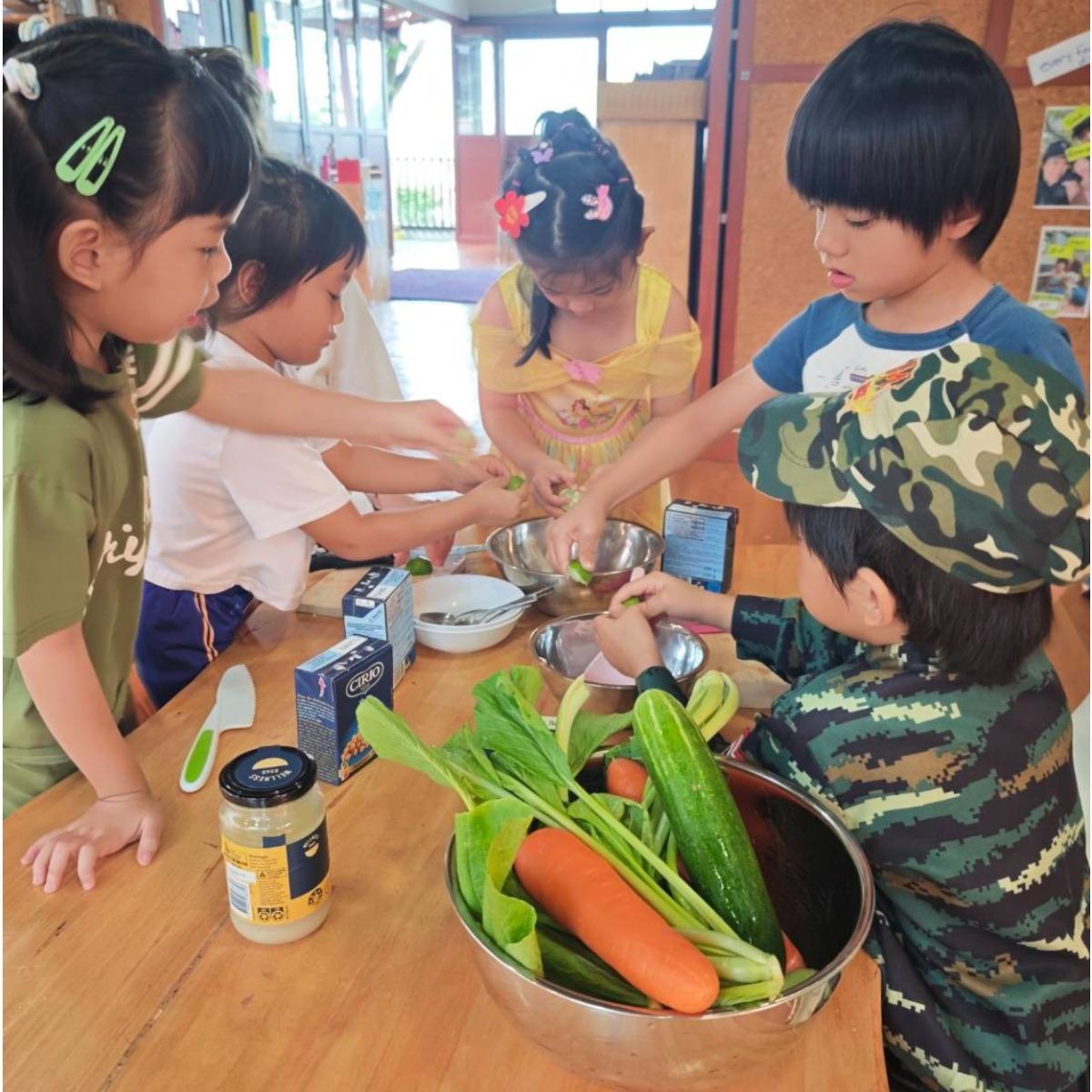
Maths or Cooking? Why not both?!

Before you continue reading, I would like for you to ask yourself this question, “What is my favorite method of learning?”  There are many categories of learning styles, and if we want the best for our children and students, some self reflection can open up a plethora of educational opportunities. For example, my favorite methods of learning are visual and hands-on. I need to feel the learning taking place and see the education before me. Which brings me to my next point, learning Maths in cooking!  The opportunities for connecting all five senses during cooking are endless. You and the children can get your hands in the mix, visually see the product being made, auditorily connect what you are doing, smell the education taking place, etc. When you begin with the recipe, the children are able to see the numbers on the page, even if the children are too young to understand fractions or comprehend numbers, exposure is the key focus. Children are investigative vacuums – what you say and do, they absorb. By simply pointing at the numbers on the page, you are helping your child snapshot that new information, even if their brains are not yet ready to fully comprehend. They are learning from your modeling that those numbers mean something, they are important.  When you are ready to begin your cooking and are gathering the ingredients, children are exposed to the names of products and what they belong to. For example, if you are cooking an egg omelette, the children will connect “egg” with the physical ingredient. Children will also learn that most foods must undergo the cooking process in order to be edible so the foods in their raw form are going to be completely different than the final product. If you need 3 eggs to make the omelette, model counting the eggs and then you just taught your child two things: eggs look different before they are cooked and counting to three.  If your child is older and can comprehend counting and numbers, then find a recipe including more complex measurements; such as ¾  teaspoon, ½ cup, etc. Explaining how these are parts of a whole and modeling how to accomplish that will bring a world of wonders to your curious child. Not only are the ingredients needing to be properly measured using maths facts, but the temperature that foods are cooked at is also a vital learning process in cooking. Children will learn that heat metamorphosizes foods and the higher the degree of temperature, the less time something will need to cook. Children will vicariously be introduced to keeping time and understanding that it is an important aspect while cooking.  By modeling cooking with your children, you are subjectively exposing them to counting, measuring, understanding number relations (number sense), telling/keeping time, all while spending time with them and practicing a skill that can be incredibly useful!  (The photograph is from K2-K3 when we made fake snow – might not exactly be cooking, but we had to follow a recipe and model how to pour 5 cups of baking soda, 1 cup of conditioner, and ⅓ cup of water!)

How Music Builds Early Math Skills: Recognizing Patterns in the Early Years

When we think of teaching math to young children, we often imagine counting blocks ornaming shapes. But what if one of the most powerful ways to introduce math doesn’tinvolve numbers at all? What if it begins with music? In the early years, children’s brains are wired for rhythm, repetition, and pattern — all which are also the foundation of mathematics. Through songs, clapping games, andsimple melodies, children begin to recognize and predict patterns, building essentialskills that support later success in math. Music is full of MathMusic and math may seem like two very different worlds, but they share a deepconnection. Both rely on patterns, sequencing, rhythm, and counting. When a childclaps along to a beat or repeats a line in a song, they are not just having fun — they’repracticing pattern recognition, a key early math concept. For example: Patterns: The Building Blocks of MathPattern recognition is one of the earliest math skills children develop. Before they canadd or subtract, children learn to identify patterns in the world around them — colors,shapes, sounds, and movements. Music provides the perfect opportunity to explorethese patterns in a fun and natural way. When children sing songs with repeated lines or rhythmic patterns, their brains areactively decoding sequences. Over time, this understanding of rhythm and repetitionlays the groundwork for:– Counting and number sense– Understanding sequences and order– Recognizing shapes and spatial relationships So when your child sways to the rhythm of a song, they’re not just enjoying the tune —they’re strengthening the same cognitive pathways they’ll later use for solving mathproblems. Easy Ways to Build Math Through Music at HomeYou don’t need to be a musician to bring math-rich music into your home! Try thesesimple activities:– Clap and Count: Sing your child’s favorite song and clap along together. Count howmany claps fit into each verse.– Move to the Beat: Dance to songs with different tempos. Ask questions like, “Is this songfaster or slower?” – Make a Pattern: Use simple sounds — clap, tap, stomp — to create a pattern (e.g., clap-tap-stomp, clap-tap-stomp). Let your child repeat it or make their own. – Sing Counting Songs: Classics like “Five Little Ducks” or “Ten in the Bed” help childrenconnect numbers with rhythm and sequence. In Tune with LearningWhen parents use music intentionally, they turn everyday moments into rich learningexperiences. Singing, moving, and listening together helps children feel the joy ofdiscovery — while building the pattern recognition skills that form the foundation ofmathematics. For more Information:https://www.naeyc.org/our-work/families/support-math-readiness-through-musichttps://education.umd.edu/importance-music-early-childhood https://www.themusicscientist.com/unlocking-early-math-skills-through-rhythm-a-developmental-approach/